Choose your language *
Construction Expertise

New living space on the rooftops of Berlin

* This page has been translated via Google's Cloud Translation API. HOWOGE does not edit the content.
Pictogram of roof extension

Enlarge instead of sealing

HOWOGE's first pilot projects for adding stories to existing buildings have been completed. This has created 50 new, barrier-free rental apartments. Potentially, another 2,000 could be built. Almost without sealing any land.

Where building land is scarce and expensive, alternative methods are needed to create more living space. The numerous roof surfaces of existing buildings offer vacant "plots" of land: A study by the Berlin Senate identified a potential for approximately 67,000 residential units.
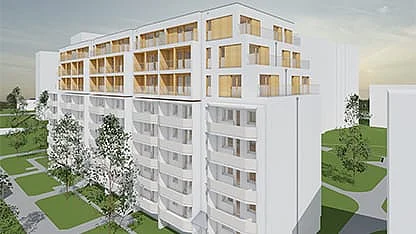
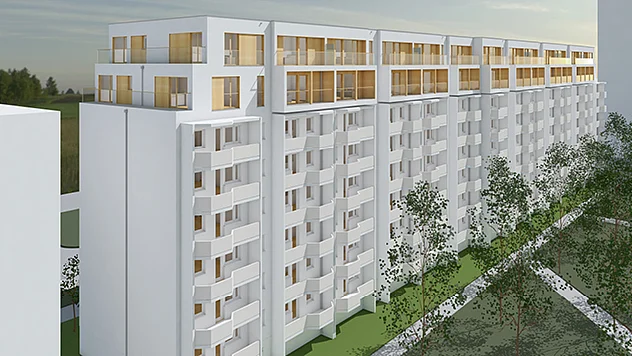
The advantages of adding stories to existing buildings are immediately obvious: No new building land needs to be acquired for the construction of new apartments, and there is little to no soil sealing. By adding new elevators, some of the existing apartments can be made accessible. Furthermore, an ecologically optimized infiltration system can be implemented for the new roof, allowing rainwater to be directed into the ground on-site instead of into the sewer system.

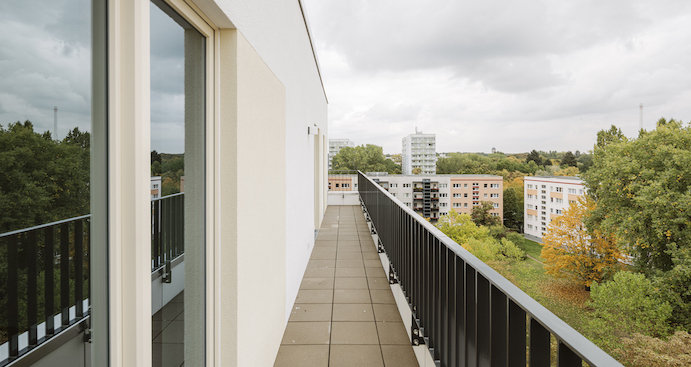
View from the roof of Franz-Schmidt-Straße.

Pilot projects – Taking the elevator to the roof

HOWOGE's properties offer over 320,000 square meters of roof area, thus theoretically providing potential for 2,000 new apartments.

HOWOGE has already added stories to two residential buildings, creating a total of 50 new apartments. These are the first two successful pilot projects for adding stories to the roofs of WBS 70 prefabricated building types.
The buildings are located in Hohenschönhausen and Buch and have been extended by two and three floors, respectively. The renovation also brings improvements for the tenants of the floors below. For example, the roof extension includes the installation of an elevator, making the building more accessible overall. Such construction work also allows for further improvements, from necessary renovations to the creation of more bicycle parking spaces.

Roof extension as a complex construction task

In the pilot projects, HOWOGE relied on timber hybrid construction . Firstly, wood is a renewable resource, and secondly, the construction is lightweight. The two WBS 70 houses are identical in terms of building type. However, despite standardization, minor variations such as a different concrete composition or a specific subsoil may necessitate adjustments in individual projects. All experience gained in the pilot projects will be incorporated into future roof extension projects and shared with HOWOGE's sister companies.

HOWOGE paves the way

Roof extensions are complex, potentially expensive, and can disrupt tenants during construction. Why is HOWOGE involved in this area? First, given the availability of valuable open spaces and expensive land, it's a pragmatic way to create living space. Second, adding stories allows for this without extensive land sealing – an important contribution to Berlin's "sponge city" concept and thus to climate protection. Third, HOWOGE is taking on a pioneering role: the more common roof extensions become, the more providers and experienced service providers can work on them. Further HOWOGE projects are planned.

Opportunities and reasons for adding a story to the roof:

  • - High land prices, room for improvement

  • - less surface sealing

  • - Pioneering work reduces costs

  • - Energy-efficient renovation of the existing building in one step with an additional story

  • - Rainwater from the roof will in the future be allowed to seep into the ground on the property.

Potential and feasibility

The potential for thousands of new apartments does not necessarily guarantee their realization. For example, urban planning regulations and the structural possibilities of adding stories to existing buildings impose limitations. Costs also need to be assessed in a nuanced way: different and potentially unknown building materials, as well as the structural properties of the building, such as foundations or escape routes, are significant factors influencing the feasibility of adding stories. Another important point is the structural condition of the existing building: construction within an existing structure always requires intensive communication with tenants, and depending on the scope of the necessary work, substantial interventions in the existing building may be required. For instance, adding stories as part of an energy-efficient renovation should not result in a double burden for the tenants and may even reduce the developer's costs.

Where we grow beyond ourselves